

Where Should a Youth Sports Club’s Money Go? A Budget Breakdown for Club Directors
The cost of playing youth sports has climbed roughly 46% since 2019, and many families now spend more than $1,000 a year on a single child’s primary sport (Aspen Institute, State of Play). That money flows straight through your club — and if you’re the director, the executive director, or the board member who got handed the budget, you’re the one responsible for turning it into a healthy season.
Here’s the problem almost every club runs into: there’s no reference point. You can see exactly what your club spends on coaching, fields, and refs. What you can’t see is whether those numbers are normal. Is 48% on coaching too much? Should you hold three months of cash in reserve, or six? Is your registration fee actually covering your costs, or are you quietly running a deficit you’ll discover in March?
This post walks through what a healthy budget looks like for youth sports clubs, academies, and leagues — soccer, volleyball, lacrosse, and everything in between — so you have a reference point for your own. Treat it as directional, not hard rules: every club is a little different, and the goal is to see where you land. The exact target for every category — plus a fillable scorecard to grade your own club — lives in the free benchmark you can download at the end.
Why most club directors are flying blind on the numbers
When directors set a budget, they usually compare themselves to the club across town — “they charge $400, so we’ll charge $400.” But you can’t see the club across town’s books, and matching their price tells you nothing about whether their spending is healthy. Meanwhile, the budget itself often lives in one volunteer’s spreadsheet, gets rebuilt from scratch every time the board turns over, and never gets measured against anything.
A budget isn’t accounting homework. It’s your club’s game plan in dollars — it tells you what you can afford, and it warns you early when you can’t. The first step to using it that way is knowing what a healthy allocation actually looks like.
Where a healthy youth sports club’s money goes
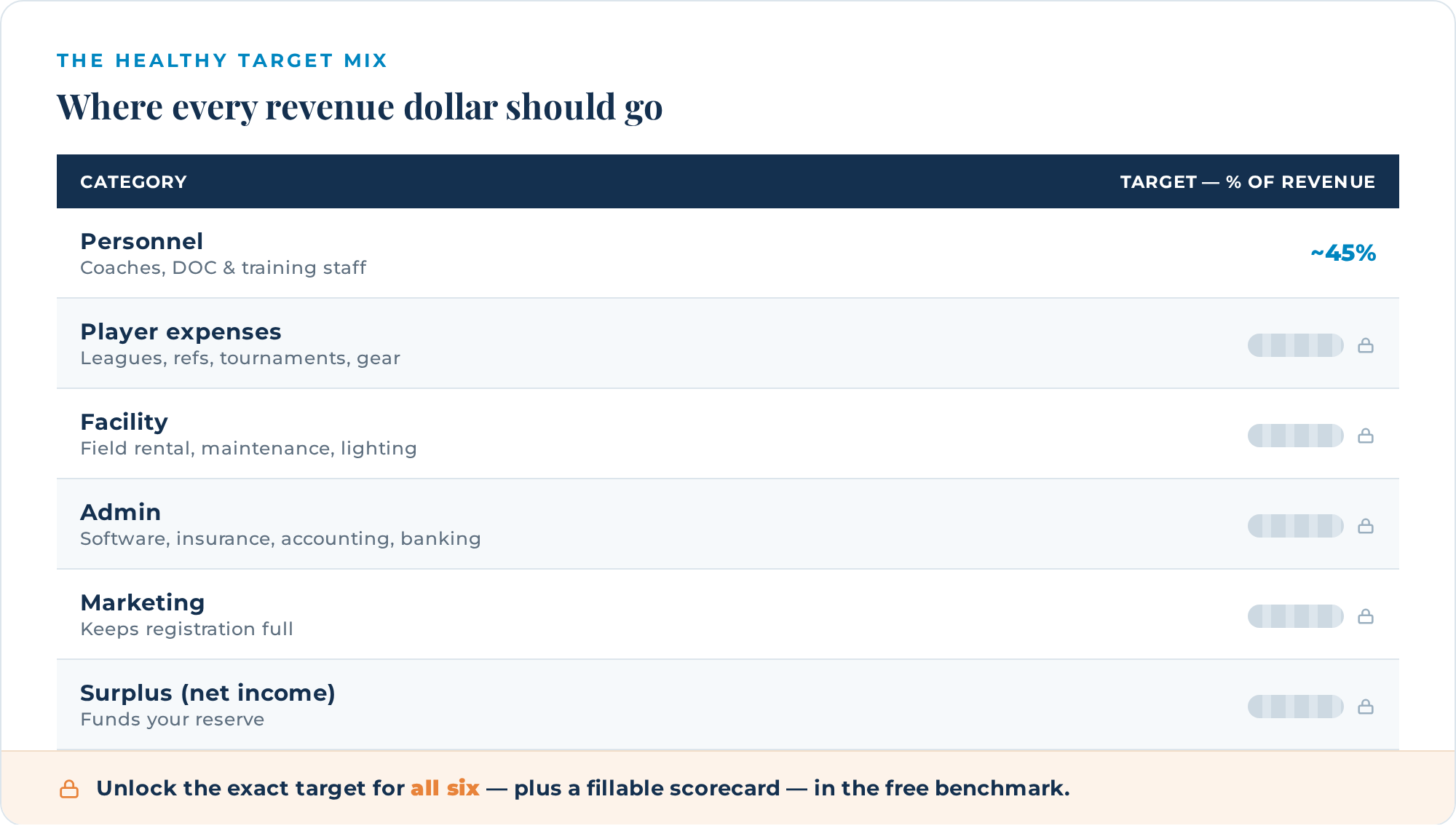
We look at club spending as six slices of every revenue dollar — five expense categories plus the surplus you keep. Here’s the shape of a healthy budget:
- Personnel — everyone on payroll: coaches, your Director of Coaching, training staff, and administrative staff. (We keep admin salaries here rather than in the overhead line — most clubs don’t have a dedicated “admin person,” and splitting salaries across categories gets messy fast.) This is almost always your single biggest line; for a healthy club it lands right around 45% of revenue, and once it climbs past ~50% it starts squeezing everything else.
- Player expenses — leagues, referees, tournaments, uniforms, and gear. The cost of actually competing, and it tends to creep up year over year.
- Facility — field and gym rental, maintenance, and lighting. Largely fixed, so it effectively sets your break-even for the season.
- Admin & overhead — software, insurance, accounting, and banking: the overhead that isn’t payroll. Lean is good; too lean and your reporting and compliance start to break.
- Marketing — usually the most underfunded line in the budget, even though a small, steady spend is what keeps registration full.
- Surplus (net income) — what’s left after expenses. A small, planned surplus isn’t greedy; it’s what funds your reserve and keeps the club stable.
Personnel is the anchor at about 45%. The other five each carry their own healthy target as a share of revenue — and it’s seeing all six side by side that tells you whether your club is actually balanced. The full target mix, with the exact percentage for every category, is laid out in the free benchmark, next to a fillable scorecard where you drop in your own numbers and see where each one lands.
The rule of thumb once you have it: any category that’s off target by 5 or more percentage points is worth a closer look — not necessarily a problem, but a question worth answering.
Where the money comes from — and the one revenue target that matters
On the revenue side, healthy clubs share one trait: they don’t lean entirely on registration. The most common source of financial fragility we see is a club where 90%+ of revenue is registration fees, leaving no cushion when enrollment dips.
The typical revenue lines for a youth sports club are registration and program fees (usually the largest by far), tournament and event hosting, sponsorships and advertising, fundraising and donations, and concessions and merchandise. We don’t hold clubs to rigid percentages here, with one exception: aim to get sponsorships, fundraising, and donations to at least 5% of revenue. That’s the line that adds cushion without raising fees on families.
Speaking of fees — this is where a lot of clubs accidentally set themselves up to lose money. Don’t price by copying the club down the road. Price from your budget:
For a club with about $1,000,000 in expenses and 500 players, that’s roughly $2,000 per player before financial aid and discounts. If that number comes out higher than your competitors, you either justify it with the value you provide or find specific line items to trim — but at least you’re making that decision with your eyes open.
Three numbers that tell you if your club is financially healthy
Beyond the allocation, three habits separate clubs that can plan and weather a slow season from clubs that lurch from one cash crunch to the next:

What this looks like for a real club
To make it concrete, we ran a real ~500-player club with a ~$1,000,000 budget against these targets. The encouraging part: every single category landed within 5 points of the healthy mix — a genuinely well-run club — with the budget breaking even and $60,000 deliberately set aside for reserves. Even then, one line had quietly drifted off target — the kind of thing that’s easy to miss until you measure it.
The full side-by-side — every category, the club’s actuals next to the target, and which lines cleared the bar — is in the benchmark, with the blank scorecard right beside it so you can run the same check on your own club.
How does your club compare?
We built a free Youth Sports Financial Benchmark so you can do this exercise on your own club. It includes the full healthy target mix, the financial health markers above, and a fillable scorecard where you drop in your own numbers and see where you sit.
Download the free Youth Sports Financial Benchmark →
Want a second set of eyes? Send us your actuals and we’ll map them against clubs your size, then walk you through the two or three things worth acting on first. It’s a financial review, not a sales pitch.
Frequently asked questions
What percentage of a youth sports club’s budget should go to coaching?
Personnel — everyone on payroll, including coaches, your Director of Coaching, training staff, and administrative staff — is typically the largest line, at around 45% of total revenue for a healthy club. Once it climbs much past 50%, it starts crowding out facilities, reserves, and everything else.
How much should a youth sports club keep in reserve?
Work toward three to six months of operating expenses. That cushion covers fixed costs like referees, fields, and payroll during the gaps between registration cycles, and it’s what lenders or partners look for if you ever finance a major project.
How do I set registration fees for my club?
Start from your budget, not your competitors. Divide your total annual expenses by your expected number of players, then add your reserve target. That’s the floor for your fee — for a ~$1M club with 500 players, roughly $2,000 per player before aid and discounts.
How often should we review the club budget?
Close your books monthly and compare actuals against your plan, then reforecast each quarter. Investigate any category that’s off plan by 5% or more while it’s still a small issue.
How do I know if my club is spending too much in one area?
Compare each category to the healthy target mix as a share of revenue. Anything off by 5 or more percentage points is worth a closer look — it’s a signal to ask why, not an automatic red flag.
This benchmark is led by Lisa Wolf, VP of Youth Sports and a former club Executive Director. Club Capital provides bookkeeping, tax, and CFO advisory for youth sports clubs, academies, and fitness businesses. Target allocations reflect Club Capital’s healthy target mix for youth sports clubs and are directional, not precise figures.
Comments